Pages

Showing posts with label History. Show all posts

Saturday, January 31, 2009

BOROBUDUR

BOROBUDUR TAMPLE

Borobudur is a ninth century monument which is a legacy "Syailendra dynasty" that follow Mahayana Buddhism, is located in magelang, Central Java, Indonesia. This square-shaped monument consists of six platforms topped by three circular platforms, and decorated with 2,672 relief panels and 504 Buddha statues. there is one main dome, which is located in the middle of the top, surrounded by 72 Buddha statues sitting in the hollow Stupa.

Borobudur is still used for pilgrimage; once a year in Indonesia celebrates Buddha "Waisak" the monument, and Borobudur in Indonesia is one of the most visited tourist attraction


BOROBUDUR STUPA

Tuesday, January 27, 2009

Pangandaran Beach

Pangandaran Beach

Many coastal tourism objects in West Java. try your visit Pangandaran beach. The beach is more or less around 80 km from the center of Ciamis regency

The object is a tourist beach pangandarann excellent beach in West Java. Located in the Village Pananjung Pangandaran, has a variety of interesting specialty.

From this beach you can enjoy the sun rise and sun set from the same place. The beach in Pangandaran have a specialty that will not disappoint you, a white sandy beach which is supported by a clear sea water and a clean environment. Beach is very safe because the manager is considering the safety beach visitors, this team proved that the coast guard that propesianal, at any time that can help you. And supported also by the many signs that were installed on the beach every corner of the beach.

in Pangandaran beach you can also see the fish and marine life that mesmerize. You can perform various activities that are fun on the beach, such as surfing, swimming, boating, fishing and even conduct activities cycling beset Pangandaran beach, it is possible because it is supported with a supporting infrastructure facilities.


On certain days this beach filled visitors / tourists domestic and foreign tourists. Activities that are usually interesting to be witnessed at the time of "Hajat laut". the activities undertaken by the public as the embodiment of Pangandaran fishermen gratitude to the kindness god.
In June or July of this beach is visited by many foreign tourists, was held at the beach is International Kite Festival.

Batu Karas Beach
For those of you who like to surf, there was a beach that was in the Ciamis regency, the beach Batu Karas. Beach is located approximately 34 km from the Pangandaran. Tourism object is located in the area of the Village Batu Karas District Cijulang.

Batu Karas Beach

Batu Karas Beach is a place that is suitable for surfing.
Surfing can actually be proficient in Pangandaran. but Foreign tourists prefer beach Batu Karas, this tour offers Object tranquility because not too crowded and congested as the beach in Pangandaran. In the area of West Java, this beach become a preferred destination other than Pangandaran Beach and Green Cayon.

The management Batu Kars Beach rent a surfboard, price offered depending on the size of the available for the small size of visitors only have to pay $1 per hour or Rp 10,000.

A matter of security at the beach this is you do not need to worry, because the manager has prepared the team is always idle. Beach has a lot of warning board coast guard and the team experienced.

Many foreign tourists visited the country to use this area travel service bureau located in Pangandaran. Usually travel agency offer travel packages at least 3 or 4 days. Within 3 or 4-day tourists will be taken to places that simply captivating.

Facilities located in the area is quite full. there are some hotels and restaurants are good.

Once you're satisfied travel tourism natural Batu Karas and Pangandaran, one more item you should visit the tour that is Green canyon.

Sunday, January 11, 2009

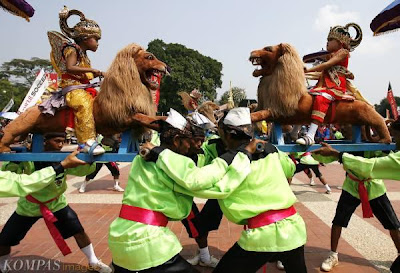
Sisingaan (Traditional Art)

Sisingaan
Subang Regency Arts Society


Sisingaan is a type of art or traditional performing arts of the people who made the procession in the form of a Bulk. The show usually displayed at the ceremony khitanan or special occasions such as welcoming guests, entertainment, dedication, Anniversary of Independence of the Republic of Indonesia and other large activities.

In his art sisingaan there are elements such as art and dance, sports (Pencak Silat and Jaipongan), karawitan art, literature and art and clothing. All these elements together form a cohesive and a dance and song and added the movement that formed a stuntman formation as standen.

Equipment used in the performance of each; stretcher sisingaan, horn, percussion, kempul, and kecrek goong. Clothing PLAYERS sundanese using traditional clothing such as shorts shucks, headgear, belt, clothes shucks sisingaan rider usually children who are in circumcision

The etimologis, sisingaan comes from the word "lion", that is a form of go-cart that looks like a lion body. Why should the form of a lion? It seems that the animal lion symbolizes courage, strength and courage.
According to art experts note (artists), art sisingaan first appeared in 1957 in the village Ciherang about 5 km south of Subang. And to develop regional Cigadung and other areas around the City Subang. Figures that are popularize Ki demang Ama Bintang, Ki Rumsi, Jani Mama Narasoma lurah, dan Ki Alhawi.

Until now, the arts sisingaan has been developing rapidly and have recorded about 200 group with the number of the artists 2695. Development is not only in the Subang area but has grown in the area of Sumedang and Bandung regency.

Because of that development, to preserve this art Subang regency government always holds festivals regularly and to promote national and provincial level, especially among the Government and the business world.


Show
The show Sisingaan basically started with a dynamic accompaniment. Then followed by a game Sisingaan by sisingaan dancers, through movement, among others: Preparation, Bangkaret, Masang / ancang-ancang, Gugulingan, Sepak dua), mundur, Kael, Mincid, Ewag, Jeblag, taktak, Gendong Singa, singa , Angkat jungjung, Ngolecer, Lambang, Pasagi Tilu, Melak cau, Nincak rancatan, dan Kakapalan (term used in the arts Sisingaan. In Sunda). Art as a direct, Sisingaan moving continuously beset village, town or street. Until finally back to where they are. In the development, train more dynamic music, and music delivered Genjring Bonyok and also Tardug.

Serving
The pattern continued Sisingaan include:
  1. Tatalu (Music played during the show started) tetabuhan or keringan
  2. Kidung or Kembang gadung (Sunda song)
  3. Tari (Ibingan) among solor, Gondang, ewang (kangsreng), catrik, and others
  4. Attraction or demonstration, usually called the attraction kamonesan in performance Sisingaan originally inspired by the attraction Ayem Adem (genjring Acrobatic) and Liong (Barongsai) (Art traditional indonesian other)
  5. Closing performance with music keringan.
Music suite.

Music Sisingaan escort initially quite simple, such as: Kendang Induk (2 pieces), Kulanter, Bonang (percussion), Tarompet, goong, Kempul, Kecrek.(Traditional music) play music and equipment tied to the body. In its development now use it (Sinden) with songs (both vocal and intrumental), among others: Keringan song, ballad song, song Titipatipa, Gondang song, song Kasreng, Selingan song (Siyur, Tepang Sono, durable rajet, Fiber salira , Honey and poisons, Pria Idaman, Goyang Dombret, Warudoyong etc.), Gurudugan song, song or Mapay Roko Mars-an (as a cover song). The song is a song in Sisingaan taken from the repertoire of Ketuk Tilu, Doger and Kliningan.(sunda traditional song )

The meaning in the song. (traditional songs western Java).

There is some significance in the performing arts Sisingaan, including:
  • The meaning of social, Subang people believe that the very soul of the people involved in them, such as egalitarian, spontaneity, and have a sense of each type of folk art that appears.
  • Meaning teatrikal, seen from the appearance of adult Sisingaan no doubt this is teatrikal, especially after the added variety, such as jajangkungan and others.
  • The meaning of a commercial, because Sisingaan able to improve their welfare, then the emergence of a number of enthusiasm and even tens of hundreds of different groups Sisingaan village to participate in the festival, this represents an opportunity, because the winner will get the business opportunities that arouse, as well as art bajidoran.
  • The meaning of universal, in each of the ethnic peoples are often owned and worship of animals Lion (Lion) (especially Europe and Africa), although in West Java there is no habitat for animal lion, but with the concept Civilitation, may not appear in the lion habitat, and received as own, as evidenced in the Sisingaan.
  • Spiritual Meaning, trusted by the community for environmental safety / (salametan) or syukuran (Pray to God)
Source:
http://id.wikipedia.org
http://www.jabarprov.go.id
Source Of Image :
http://images.kompas.com
http://database.deptan.go.id

Friday, January 09, 2009

Raja Ampat Islands

Raja Ampat Islands " One of Wonder World"

Located in the Coral Triangle, the heart of the world’s coral reef biodiversity, the seas around Raja Ampat possibly hold the richest variety of species in the world—an incredible 75% of all known coral species are found in the surrounding seas.


The Raja Ampat, or “Four Kings,” archipelago encompasses more than 9.8 million acres of land and sea off the northwestern tip of Indonesia’s West Papua Province. Located in the Coral Triangle, the heart of the world’s coral reef biodiversity, the seas around Raja Ampat possibly hold the richest variety of species in the world.

The area’s massive coral colonies show that its reefs are resistant to threats like coral bleaching and disease —threats that now jeopardize the survival of corals around the world. In ad
dition, Raja Ampat’s strong ocean currents sweep coral larvae across the Indian and Pacific Oceans to replenish other reef ecosystems. Raja Ampat’s coral diversity, resilience to threats, and ability to replenish reefs make it a global priority for marine protection.


The Conservancy’s ultimate goal is to protect Raja Ampat’s magnificent reefs while sustaining the livelihoods of local people. Raja Ampat includes the four large islands of Waigeo, Batanta, Salawati, and Misool, plus hundreds of smaller islands. The archipelago is part of an area known as the Bird’s Head functional seascape, which also contains Cenderawasih Bay, the largest marine national park in Indonesia.

Uniqueness under the sea

The Raja Ampat Islands are found off the coast of Papua, Indonesia, in one of the remotest areas of the world for scuba diving.


Pygmy Seahorse

Pygmy Sea Horses which were once thought to be rare, are common here and of different varieties. Seen along with the sea horses are pipefish and flagtail pipefish.

Many colorful flat worms, nudibranchs and sea slugs dot the reef. Flashing File Clams are named for their unusual bioluminescence that streaks along the edge of there mantle. They are found here.

The Raja Ampat Islands gives us the opportunity to see an abundance of marine animals seen in few other places in the world


.
Coral Raja Ampat

HISTORY OF BEMO (PUBLIC TRANPORT)

"BEMO" public transport that marginalized

Two or three years ago, still have ago thatch-vehicle called BEMO
"BEMO" has three wheels. Almost unique shapes similar to Bajaj.

Two years ago, public transport is still faithful take my son to leave school. but has now been replaced with the city transportation (Angkot)
Now living history, even one of the crossroads in my city until now is still popular with the name "Pesimpangan BEMO" the crossroad of bemo

BEMO